
Memory Care Near The Woodlands, TX
A sixteen-resident home for older adults living with Alzheimer’s disease and other forms of dementia, opening Spring 2027, minutes from The Woodlands.
What Is Memory Care Near The Woodlands, TX?
Memory care is residential care designed for people living with Alzheimer’s disease and other forms of dementia who need specialized support, increased supervision, and a structured environment.
Assisted living and memory care often provide similar daily support services, help with bathing and dressing, meals, and medication, but memory care includes additional dementia-specific training, supervision, and environmental considerations.
The physical environment plays an important role in memory care. When someone has difficulty recognizing rooms, remembering directions, or finding their way from one place to another, a simpler layout can make daily life easier.
Routine is another important part of memory care. Consistent schedules often make it easier for people living with dementia to know what to expect from the day.
Care partners are also trained for the day-to-day changes dementia often brings. Dementia is often less about forgetting a name and more about changes in judgment, orientation, language, and perception. A person may struggle to find the right word, become confused about where they are, or believe they’re responsible for something that happened years ago.
If you’re still deciding what level of support your parent needs, our overview of what memory care involves covers it generally, and our guide comparing assisted living and memory care lays the two side by side.
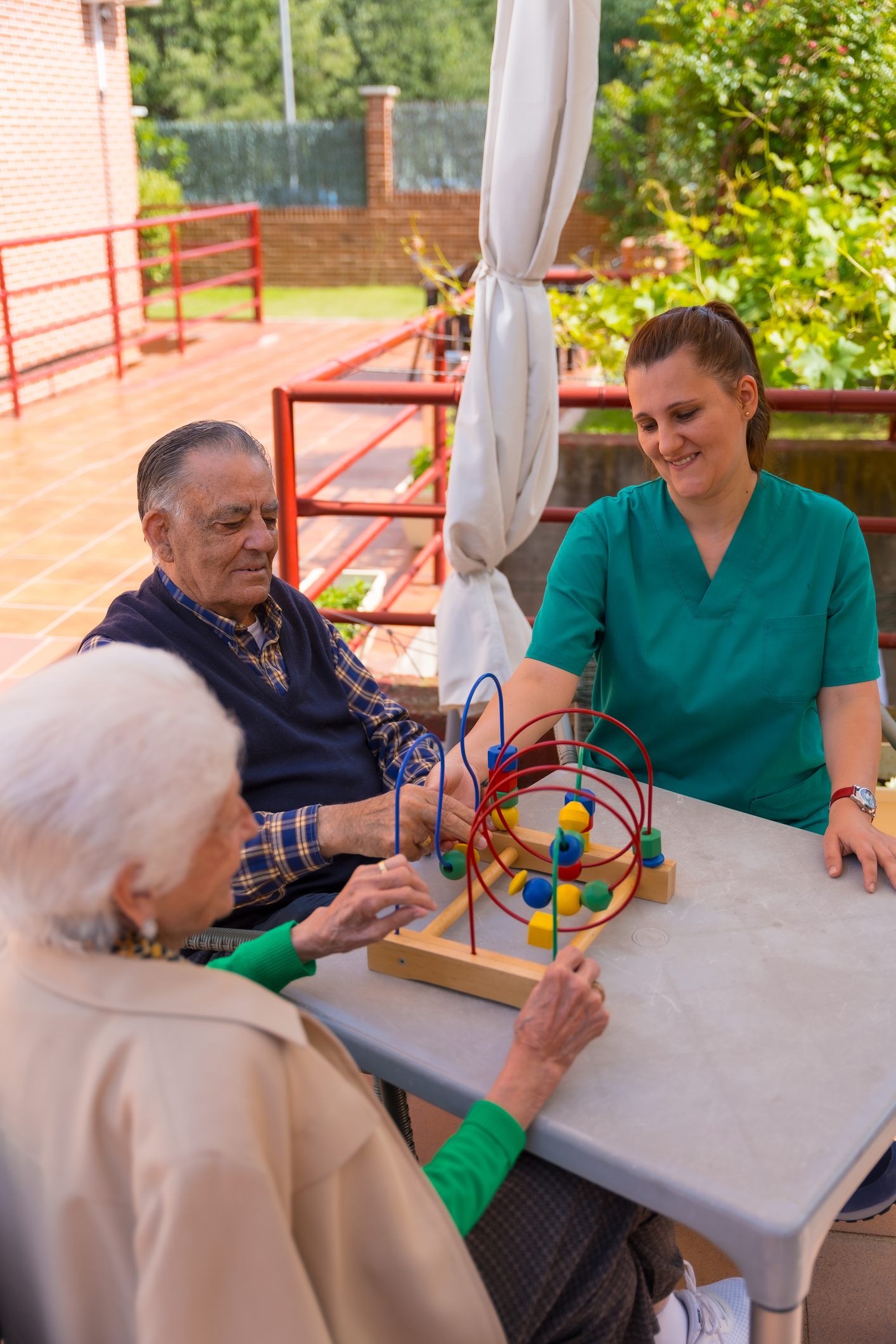

Memory Care in a House, Not a Wing
Most memory care near The Woodlands takes place within a larger community. A secured wing off a main corridor, or a separate memory care building on a campus, usually serving several dozen residents. Those communities can be very good, and for some families they’re the right answer.
A Vibrant Life will be a house with sixteen bedrooms, and memory care won’t be a separate part of it. Assisted living and memory care will happen in the same home, with the same care partners, at the same sixteen-person scale.
One place that difference becomes especially noticeable is when care needs change. In most communities, a resident whose dementia progresses moves from assisted living into the memory care wing or building. For someone living with dementia, adjusting to a new room, new routes, and new care partners can create additional challenges. Here there’s nowhere to move to.
Consistency becomes increasingly important as memory becomes less reliable.
Where a Larger Community Is the Better Answer
It’s equally important to understand what this model is designed to do and where another setting may be more appropriate. Sixteen bedrooms means we won’t be built for every stage of dementia. If your mother needs two-person transfers, or medical care beyond what assisted living and memory care can provide, a nursing home or a community with skilled nursing on site is the safer answer, and we’ll say so rather than accept an admission we can’t support. Our floor plan page shows exactly what the home is and isn’t.


Ask Which Disclosure Statement You’ll Receive
Texas requires any community that advertises memory care to give families a written disclosure statement before admission, explaining how its dementia care is delivered.
Most families don’t know this question exists, but it can tell you a great deal about how a memory care community operates.
The term memory care can mean different things from one community to another. The Texas Legislature recognized that, which is why state law now requires every community that advertises, markets, or promotes memory care to provide a written disclosure before anyone is admitted. That document is HHSC Form 3650.
Separately, Texas licenses communities specifically for Alzheimer’s care. A community holding that certification has to give you a second document, HHSC Form 3641, in addition to the first.
That’s why we encourage families to ask which forms they’ll receive before admission. If a community provides Form 3650 and not Form 3641, it has told you in writing that it is not Alzheimer’s certified.
Asking to review a community’s dementia disclosure documents is one of the most effective ways to compare memory care programs in Texas.
The disclosure must also explain the community’s aging in place policies and the waiver process. That’s where you find out, in advance and in writing, what would cause your loved one to be asked to move. Our guide to questions worth asking before choosing memory care covers what a solid answer sounds like.
Ask us the same question you’d ask anyone else. We’ll walk you through our licensing and certification status, and provide the disclosure documents Texas requires, when you tour or call. Because we haven’t opened yet, there are no numbers to publish on this page today.
How Families Know It May Be Time
Most families begin exploring memory care after noticing changes that are becoming harder to manage safely at home. These are the ones that come up most often.
Getting Turned Around in Familiar Places
Maybe your father took a wrong turn coming home from the church he’s driven to for thirty years. Maybe your mother stood in her own hallway trying to work out which door was the bathroom. Disorientation in familiar surroundings is different from ordinary forgetfulness, and it tends to be the change families remember most clearly afterward.
The Late Part of the Day Is the Hard Part
Families often notice that mornings still feel familiar, but afternoons and evenings become more challenging. Around four or five o’clock there’s more agitation, more pacing, more insistence about leaving or finding someone who isn’t there. Many people living with dementia become more confused as daylight fades, and it’s often the point at which one family caregiver stops being enough.
Nights Have Stopped Being Nights
Maybe you’ve moved into the spare room to listen for the front door. Maybe you sleep with the car keys somewhere they can’t be found. When you’re waking three or four times to check, you’re not really sleeping, and that catches up with a person faster than most families expect.
The Stove, the Front Door, the Car Keys
Maybe a burner was left on after cooking. Maybe a door was found unlocked in the morning, or a drive ended somewhere nobody meant to go. Wandering and kitchen safety are the two risks that most often move a family from watching to acting, because the consequences can be serious.
Assisted Living Is Already Doing All It Can
Some families begin exploring memory care after a loved one has already been living in an assisted living community. The support that worked well a year ago may no longer be enough to safely meet their needs. You may have started hearing terms like elopement risk or one-to-one supervision. If you’re at that point, our guide on when it may be time for memory care walks through the signs, and our overview of specialized Alzheimer’s care by stage explains how needs change over time.
What Memory Care at A Vibrant Life Will Include
Every resident’s care plan will reflect their own needs, routines, and history, and will be adjusted as those needs change over time, following standards set by our founders, a registered nurse and a healthcare executive.
Dementia-Specific Care
- A written care plan built from your loved one’s history, habits, and what helps them feel comfortable and secure, revisited as needs shift
- Care partners trained in dementia communication and in responding to agitation without escalating it
- Medication management, including the timing changes that often matter more in dementia than the doses themselves
- Help with bathing, dressing, grooming, and mobility, while respecting each person’s comfort, preferences, and daily rhythm
The Shape of the Day
- A predictable daily rhythm, since routine does more for orientation than reminders do
- Music, baking, gardening, chair yoga, and hands-on activities that don’t depend on short-term memory to be enjoyable
- Virtual reality experiences that can prompt reminiscence without requiring anyone to leave the house
- Chef-prepared meals at a table small enough that mealtimes stay social rather than loud
Safety Without a Locked-Down Feeling
- Secured entries and exits, with freedom to move throughout the home and into the garden
- Wearable monitoring worn discreetly, used to tell care partners something is happening rather than to watch anyone
- Care partners in the home around the clock, awake overnight
- Step-free showers and bathroom grab bars throughout, so nothing has to be climbed over or reached for
Families Stay Involved
- Direct contact with the people actually providing care, not a message routed through a front desk
- Honest updates when something changes, including the things families would rather not hear
How the Layout Supports Someone Living With Dementia
How a home is laid out affects both orientation and supervision. Long corridors, repeating doorways, and identical wings are hard to navigate for someone whose sense of place has become unreliable, and they also block the sightlines that let care partners keep track of where people are.
Our home has two short hallways that meet at one open center where the kitchen, dining table, and living area sit together. From a bedroom door, the people are already in view. There’s no corridor to solve and no wing to pick.
It works in the other direction too. A care partner standing in the kitchen can see the dining area, living room, and both hallways at once, making it easier to stay aware of where residents are without constantly shadowing them.

Serving Families Throughout The Woodlands Area
A Vibrant Life Assisted Living and Memory Care is located at 15520 Bedford Ln, Conroe, just west of The Woodlands in the 77384 zip code. Families in Sterling Ridge, Alden Bridge, Creekside Park, Cochran’s Crossing, Panther Creek, College Park, and Grogan’s Mill reach us by FM 1488 or Research Forest Drive.
Family involvement remains important in memory care, which is why location matters. Long visits are often harder than short ones, and a familiar face appearing regularly tends to do more good than a longer stay every few weeks. The question worth asking about any location is whether you could realistically stop in on a Wednesday for twenty minutes, not just on Sundays.
We’ll welcome families from across The Woodlands villages, Shenandoah, Oak Ridge North, Conroe, Spring, Tomball, Magnolia, and Montgomery County. If your search covers both markets, you can also look at our memory care in Conroe page, and for anyone whose needs haven’t reached this level, our assisted living near The Woodlands page covers that side of the home.
Our home has two short hallways that meet at one open center where the kitchen, dining table, and living area sit together. From a bedroom door, the people are already in view. There’s no corridor to solve and no wing to pick.
It works in the other direction too. A care partner standing in the kitchen can see the dining area, living room, and both hallways at once, making it easier to stay aware of where residents are without constantly shadowing them.
What Memory Care Costs Near The Woodlands
Memory care generally costs more than assisted living, and the reason is staffing and training rather than square footage. What a family pays usually depends on how much hands-on support a person needs, how much of that support falls outside daytime hours, and how much is bundled into the monthly rate rather than billed on top. Families rarely cover it from one source, so our guide to how families pay for memory care walks through long-term care insurance, VA benefits, and Texas programs. We encourage families to discuss pricing early in the process so there are no surprises later.
Questions Families Ask About Memory Care Near The Woodlands
Is A Vibrant Life a memory care community or an assisted living community?
Both, in one house. Sixteen private bedrooms will serve residents who need assisted living and residents who need memory care, with the same care partners across the whole home. There’s no separate memory care wing or building here. You can read about that side of the home on our residential assisted living near The Woodlands page.
Why do families choose memory care near The Woodlands instead of remaining at home?
Families often consider memory care when safety concerns, wandering, disrupted sleep, medication management, or increasing supervision needs become difficult to manage consistently at home. The decision is usually less about a single event than about whether the level of support required has outgrown what one household can provide around the clock.
Why do some families choose residential memory care?
Families choose residential memory care homes for different reasons. Some prefer a smaller environment. Others value familiar care partners, a consistent routine, or a setting that feels less overwhelming for a loved one living with dementia.
Will my mother have to move if her dementia progresses?
Not for a change from assisted living to memory care, because both happen in the same home. She would need to move if her needs went beyond what this home is licensed and staffed to provide, which generally means a level of medical care requiring skilled nursing. Texas requires every community to put its aging in place policy in writing before admission, so ask for that document here and everywhere else you tour.
What documents should a Texas memory care community give me before admission?
At minimum, HHSC Form 3650, the Assisted Living Facility Memory Care Disclosure Statement, which Texas requires of any community that advertises or promotes memory care. A community that is Alzheimer’s certified must also give you HHSC Form 3641. If you receive the first and not the second, the community is telling you in writing that it does not hold Alzheimer’s certification.
How many residents will live at A Vibrant Life?
Sixteen in total, each in a private bedroom with a private ensuite bathroom. Texas classifies a community licensed for sixteen residents or fewer as small, which puts this home at the top of that category and well below most memory care options near The Woodlands.
Which forms of dementia will A Vibrant Life support?
Care partners will be trained to support residents living with Alzheimer’s disease, vascular dementia, Lewy body dementia, frontotemporal dementia, mixed dementia, and mild cognitive impairment with rising care needs. What matters more than the diagnosis is how a person is affected day to day, which is what the care plan is built around.
How is memory care different from a nursing home?
A nursing home provides skilled nursing care with licensed nurses on site around the clock, and it’s the right setting when someone’s medical needs are the primary issue. Memory care is residential, and it’s built around cognition, safety, and daily structure rather than ongoing medical treatment. Many people living with dementia never need a nursing home. Some eventually do.
Is memory care more expensive than assisted living?
Usually, yes. The difference comes from more care partner hours per resident, dementia-specific training, and overnight coverage, not from a larger apartment. When comparing communities, ask what’s included in the base rate and what gets billed separately, since that varies more between communities than the headline number does.
When will A Vibrant Life open?
Spring 2027. Everything on this page describes what we’re building rather than care we’re currently providing. You’re welcome to contact us now with questions, and to visit as soon as we’re able to open the doors.
If you’re early in this and just want to talk it through with someone, that’s a fine reason to call. Schedule a private visit for later, or reach out now with a question about where your family is right now. Live Vibrantly.
Medical Disclaimer
This page is general information about residential care options and is not medical advice or a diagnosis. Dementia affects each person differently, and decisions about care should be made with a physician, neurologist, or other qualified clinician who knows your family member. A Vibrant Life Assisted Living and Memory Care is a residential community, not a hospital or a licensed medical provider.